
Research-First Evaluation OS
RLM Code
Research Playground for Recursive Language Models
Run real RLM workflows, benchmark them, replay every step, and compare results under controlled budgets and secure sandboxes.
Open source under Apache-2.0. Explore the project on GitHub.
Is RLM revolutionary or just another coding agent?
The debate is active. RLM Code gives researchers a way to test claims directly with reproducible runs, benchmark comparisons, trajectory replay, and cost and token tracking.
You do not need to pick a side first. You can run the same tasks, inspect the traces, and decide with evidence.
Latest release
Harnesses designed for compositional generalization
RLM Code v0.1.11 implements the harness mechanisms from Language model harnesses are compositional generalizers by Alex Zhang and Omar Khattab. Full breakdown in our post.
Full history and root observations, for compatibility and reference experiments.
Bounded evidence previews and decomposition guidance, for repository analysis.
Opaque status only, for length and cross-domain generalization research.
Use your preferred stack
Mix runtimes, framework adapters, and observability tools without changing your research workflow.
Runtimes
Frameworks
Observability
Built for research workflow
Implementation friction: get a runnable RLM loop without custom scaffolding
Experiment management: run, compare, replay, and export results in one place
Security controls: use secure runtime profiles and explicit unsafe opt-ins
Reproducibility: keep traces, metrics, artifacts, and benchmark history
Operational visibility: inspect events, rewards, tokens, and runtime health
What is included
Core capabilities for running reproducible RLM experiments end-to-end.
Research Lab TUI
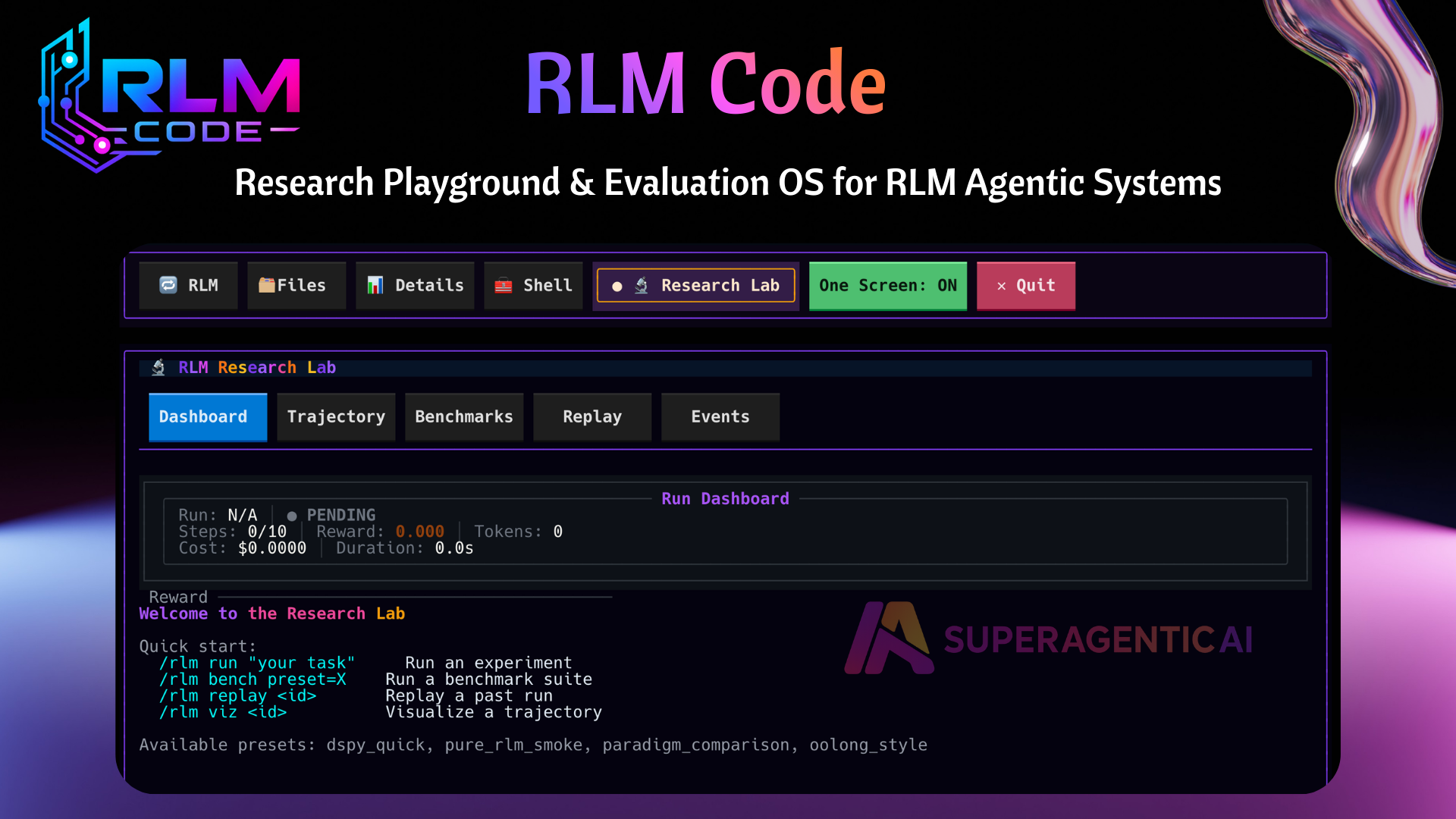
Dashboard, Trajectory, Benchmarks, Replay, and Live Events in one focused interface.
Benchmark System
Built-in benchmark presets, leaderboard metrics, run comparison, and report export.
Session Replay
Step through decisions and outcomes to inspect behavior, not just final answers.
Superbox Sandbox Layer
Policy-based runtime selection and fallback across Docker, Apple Container, and cloud runtimes.
Framework Adapter Registry
Compare execution across DSPy RLM, ADK, Pydantic AI, Google ADK, and DeepAgents.
Observability Integrations
Connect MLflow, Logfire, LangSmith, LangFuse, OpenTelemetry, and local JSONL sinks.
Watch RLM Code in action
Install, connect, run a bounded RLM task, benchmark, compare, and inspect replay in the Research Lab, then see the same harness demonstrated live on stage.
Product walkthrough
AI Engineer World’s Fair 2026 talk
“RLM: Recursive Language Models for Large Codebases,” delivered by Shashi Jagtap, Founder of Superagentic AI, with a live demo run on RLM Code. View the slide deck, explore the demo repository, or read the recap post.
From install to measurable result in minutes
$uv tool install "rlm-code[tui,llm-all]"$rlm-code>/connect>/sandbox profile secure>/rlm run "small scoped task" steps=4 timeout=30 budget=60>/rlm bench preset=token_efficiency>/rlm bench compare candidate=latest baseline=previous>/rlm observabilitySafe and bounded by design
Secure profile sets Docker-first execution defaults
Unsafe exec mode requires explicit acknowledgment
Step, timeout, and budget controls prevent runaway runs
/rlm abort allows immediate cancellation
Runtime doctor and status commands expose readiness and misconfigurations
Research-first audience
Who it is for
- Researchers evaluating long-context reasoning methods
- Applied AI teams validating execution patterns before product rollout
- Framework authors testing adapter behavior in a unified benchmark harness
Not the primary target
- One-click consumer chat workflows
- Unbounded autonomous production agents without evaluation controls
FAQ
Can I use MLflow and Logfire at the same time?
Yes. Multiple observability sinks can run together.
Can I compare RLM with other execution paradigms?
Yes. Run benchmarks and compare runs with consistent bounds and metrics.
Can I use local models?
Yes. Local and BYOK routes are supported.
Is secure execution required?
For serious experiments, yes. Use secure sandbox profiles by default.
Which Pure RLM profile should I start with?
Use repo_evidence for repository analysis with bounded evidence, or lid for length and cross-domain generalization research. reference exists mainly for compatibility with earlier configurations.
Stop arguing. Run the experiment.
Use RLM Code to test what works for your tasks, constraints, and models.
RLM Code is built and maintained by Superagentic AI. We also work with teams directly on agent experience, engineering, optimization and delivery. See how we work with teams.