
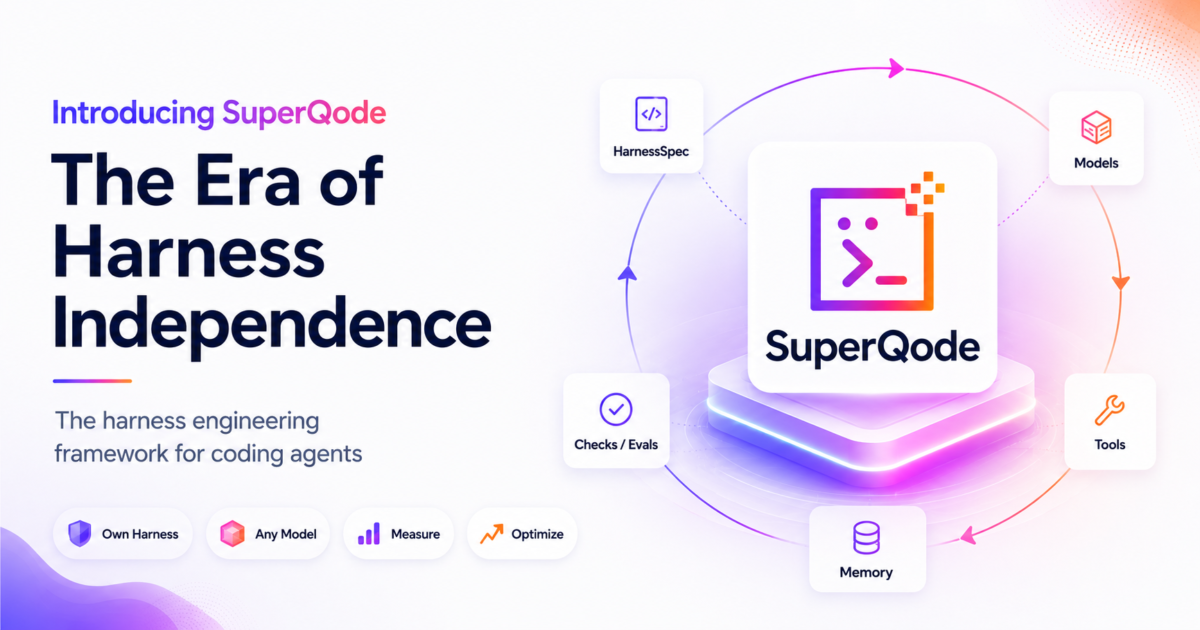
The Agentic coding agent market has spent the last year focused on model independence. That focus remains important, but it is no longer sufficient. A coding agent consists of a model running inside a harness. The harness determines what the model can see, which tools it can call, how it edits files, how it searches a repository, how it maintains context and memory, how it requests approvals, how it runs checks, and how it recovers from failure. That's where Harness Engineering comes in picture. If you do not control the harness, you do not fully control the agent.
Most proprietary coding agents combine their model and harness into one closed system. The results can be strong, but the arrangement creates a new form of lock-in. You become tied not only to a model provider but also to the hidden engineering decisions that shape tool use, context handling, memory behavior, approval flows, and verification logic. Open coding agent harness tools address part of the problem by allowing model provider choice. Model routing alone, however, does not deliver harness independence. When the harness was built for one model family, switching models often produces weak tool calling, poor context management, fragile edits, missing verification steps, or unsuitable approval rules.
SuperQode is a harness engineering framework for coding agents, optimized for local and open models. It lets teams build, inspect, version, run, measure, and optimize the harness as a first-class engineering artifact that lives in the repository.
The Problem With Model Independence
Model independence appears straightforward: select a provider and route prompts to a different model. For basic chat applications this can suffice. For coding agents it does not. Coding agents depend on far more than raw model intelligence. They require context management, repository search, tool schemas, edit formats, shell access, approval policy, memory, verification, retries, event handling, and workflow design.
A model that performs well in one harness can perform poorly in another. Local models often need prompt-based tool calling rather than native function calls. Smaller models benefit from tighter context, simpler tools, and stronger verification. Frontier models may tolerate ambiguity that open models cannot. A review agent requires read-only access while an implementation agent needs controlled write access.
When the harness remains hidden, these decisions are made for you. When the harness is fixed, your project must adapt to it. When the harness is tuned for one vendor model, switching models becomes fragile. Model independence without harness control leaves the most important part of the agent system outside your control.
The Second Lock-In: Harness Lock-In
The first generation of lock-in was model lock-in. The next generation is harness lock-in. Proprietary coding agents can optimize their harness deeply for their own models. The provider controls the model, the tool loop, the system prompt, memory behavior, approval flow, and runtime environment. Everything can be tuned together. The difficulty is that the user does not own that system. You cannot inspect the full harness. You cannot version it alongside your repository. You cannot reliably measure a change in the harness against your own tasks. You cannot adapt it deeply for a local model, a cheaper provider, a specialized runtime, or a team-specific workflow.
Over time your engineering process begins to conform to someone else’s hidden agent loop. If a new model becomes available, you evaluate not only the model but whether it fits a harness you do not control. If the harness changes, your workflow can shift without a clear diff. If the provider alters its strategy for memory, tools, approvals, or context, your team inherits that decision. That arrangement is not independence. It is dependency through abstraction.
Open Harnesses Still Require Engineering
Open source coding agents represent an important step forward. They make more of the system visible and frequently support multiple model providers. Openness by itself does not solve the full problem. A harness must be engineered for the specific model, repository, task, runtime, and safety policy. No single fixed loop can be optimal for every model family, every local server, every team workflow, and every codebase.
Open models make the requirement especially clear. The weights are available, yet they arrive without the surrounding agent system that makes them effective for real software work. A capable open model can appear weak if the harness wastes context, exposes too many tools, assumes unreliable native tool calls, skips verification, or supplies the wrong edit format. The model is only one part of the system. The harness determines whether that model becomes useful.
Harness Engineering
Harness engineering is the discipline that follows prompt engineering and context engineering. Prompt engineering asks what instruction to give the model. Context engineering asks what information to place around that instruction. Harness engineering asks how the entire agent system should operate. This includes model routing, available tools, repository access, memory strategy, context budget, edit strategy, shell policy, network policy, approval rules, sandboxing, workflow topology, verification steps, event traces, and the optimization loop.
For coding agents this layer is now decisive. The harness is where reliability, safety, cost, and portability are engineered. Recent work in the field has formalized useful mental models. One approach distinguishes guides, which steer agent behavior before generation, from sensors, which detect and correct issues afterward. Production examples, such as an OpenAI team that maintained and extended an internal product of roughly one million lines of code using agents with zero manually written lines, show what becomes possible when teams treat harness design as a primary engineering activity.
SuperQode treats the harness as a real software artifact. It can be reviewed, tested, compared, shared, and improved.
Enter SuperQode
SuperQode exists for teams that want to own the harness. In SuperQode a harness is a versioned specification that lives in your repository. It defines the runtime, model policy, tools, memory, search, sandbox, approvals, workflow, checks, output behavior, and observability for an agent run.
You can create it with a wizard. You can start from model family templates. You can explain it in plain English. You can validate it. You can run it in the TUI, from the CLI, in CI, through MCP, or behind another runtime. You can measure it with evals and benchmarks. You can optimize it as your models, tasks, and project evolve.
The central idea is straightforward. You should not rent the harness that runs your engineering workflow. You should own it.
Open Models are getting Incredibly Smart
Open models are becoming capable enough for serious software work. Many day-to-day coding tasks do not require frontier intelligence for every step. Repository inspection, search, summarization, review, small fixes, log analysis, migration planning, and verification can often run through local or lower-cost routes when the harness is designed correctly. Frontier models still matter. Some tasks need the strongest available reasoning. They should remain a deliberate choice rather than the default cost on every agent loop. The future is not one model for every task. The future is routing the right level of intelligence to the right work under a harness that you control.
SuperQode is built around that principle. Use local models when they are sufficient. Use BYOK providers when they fit. Use frontier models when the task justifies them. Keep the harness consistent across all of those routes.
Cost Independence
Harness independence is also cost independence. When your agent loop belongs to a vendor, the natural path leads back to that vendor’s model and billing system. Every search, retry, planning step, review pass, and verification loop can become another expensive model call. SuperQode provides a different operating model. Routine work can run on local or lower-cost models. Specialized tasks can use the provider you prefer. Frontier models can be reserved for the moments that truly need them.
The goal is not to avoid powerful models. The goal is to stop paying frontier prices for every step of the workflow. A team should be able to decide where intelligence is required, where local execution is sufficient, and where cost can be reduced without surrendering the agent capabilities around the model.
What SuperQode Provides
SuperQode supplies a complete framework for building and operating your own coding agent harness.
- Define a portable HarnessSpec that controls runtime, model policy, tools, memory, search, sandboxing, approvals, workflows, checks, and output behavior.
- Create a harness through the TUI wizard or CLI wizard, begin with model family templates, inspect the resolved policy with harness explain, validate it with harness doctor, compare versions with harness diff, and run it from the TUI, CLI, scripts, or CI.
- Connect to local models through Ollama, LM Studio, MLX, DS4, vLLM, and SGLang. You connect to hosted providers through BYOK. You connect to existing agents and tools through ACP, MCP, and A2A.
- Run the same harness contract across the built-in runtime, OpenAI Agents SDK, Codex SDK, Claude Agent SDK, Google ADK, DeepAgents, and PydanticAI.
- Use local code intelligence with bounded file reads, repository search, local code search, multi-repository search, semantic search, offline indexes, and post-edit verification.
- Control safety through explicit file access, shell access, network policy, approval profiles, sandboxing, project trust, MCP controls, plugin policy, and command restrictions.
- Use memory systems that remain under your control, with local project memory by default and provider-neutral memory integrations when needed.
- Run local dynamic workflows with RLM for recursive analysis over logs, traces, diffs, repository slices, and long evidence chains.
- Measure behavior through harness tests, eval scorecards, agentic benchmarks, event graphs, run evidence, and regression gates.
- Optimize model routes, harness candidates, and skills without blindly rewriting the live system.
Local and Open Model First
SuperQode is designed for the practical requirements of local and open model work.
- Need accurate context budgets. SuperQode detects loaded context windows and compacts before overflow.
- Need efficient context usage. SuperQode employs bounded reads, line-numbered output, continuation hints, output spill files, local search, and compact previews.
- May require different tool call strategies. SuperQode supports model-aware tool formats, repair paths, corrective feedback, and safer edit formats.
- Local workflows need verification. SuperQode can run checks, post-edit validation, smoke tests, and evals around the harness.
- Local teams need control. SuperQode supports Airplane Mode, local indexes, local memory, strict network removal, and offline-friendly harnesses.
Open models do not need to imitate proprietary products. They need harnesses designed for their strengths and limitations.
Harness Independence Defined
Harness independence means you own the agent loop, choose the model, choose the tools, choose memory and context behavior, choose approval and sandbox policy, You can measure whether the harness works, optimize it for your project. move between local, BYOK, proprietary, and open models without rewriting the workflow. In short you control your Agentic Engineering.
Example Flow
Install SuperQode with uv.
uv tool install superqodeLaunch it inside a repository.
cd your-project
superqode
Create your first harness in the TUI.
:connect local
:harness wizard
Press Enter through the defaults for a runnable local coding harness, choose an output file, and load it.
Then ask the agent to work inside that harness.
Read README.md and summarize this project.For CLI usage the same workflow is available directly.
superqode harness wizard
superqode harness explain --spec harness.yaml
superqode harness doctor --spec harness.yaml
superqode harness run --spec harness.yaml --prompt "summarize this repository"
The result is a harness you own, inspect, and improve.
The Era of Harness Independence
The next phase of coding agents will not be defined only by larger models. It will be defined by who controls the system around the model. Teams need the freedom to choose any model. They also need the freedom to design the harness that makes that model useful.
They need local execution when privacy, cost, or latency matters. They need hosted models when scale or frontier capability matters. They need protocol integration when existing tools already work. They need measurement when reliability matters. They need policy when safety matters. They need optimization when the work changes.
Most of all, they need ownership. SuperQode is built for that ownership. It is the first framework designed around harness engineering for coding agents. Its purpose is to help developers and teams build their own agent loop, connect the models they choose, measure real performance on their own repositories, and improve the system on their own terms. This is the era of harness independence.
Build your harness. Choose your models. Measure the results. Optimize the system. Own the agent loop.
Please checkout SuperQode on GitHub and explore extensive docs. Any feedback appreciated.